
How to Make an Herbal Tincture: A Beginner’s Guide to Alcohol Extracts
Herbal tinctures are one of the most convenient ways to prepare and preserve herbs. They are concentrated liquid extracts made by soaking plant material in a solvent—called the menstruum—for an extended period of time.
For the tinctures discussed here, that solvent is a mixture of ethyl alcohol (ethanol) and water.
Alcohol is particularly useful because alcohol and water extract different types of plant constituents. By adjusting the percentage of alcohol in the menstruum, an herbalist can tailor an extraction to the particular plant and the constituents they are trying to extract.
Tinctures are also naturally well preserved when formulated with sufficient alcohol. A useful general guideline is to keep the finished preparation at approximately 25% alcohol or higher for long-term preservation.
Before You Begin: Ratios and Alcohol Percentages Matter
There isn't one tincture recipe that is ideal for every herb.
Two important pieces of information accompany a professionally formulated tincture:
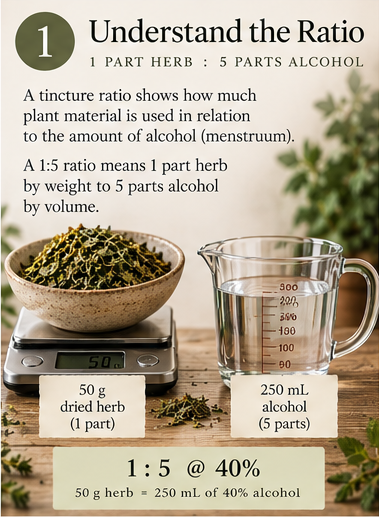
The extraction ratio tells us how much plant material was used relative to the amount of menstruum.
The alcohol percentage tells us the concentration of ethanol in that menstruum.
You might therefore see a tincture written as:
1:5 @ 40%
This tells us that the tincture was prepared using 1 part herb by weight to 5 parts menstruum by volume, with a menstruum containing 40% alcohol.
For example:
50 grams dried herb + 250 mL of 40% alcohol = a 1:5 tincture.
The ratio is important because it makes the preparation reproducible rather than relying on how tightly herbs happen to fit into a jar.
Making a Basic 1:5 Dried-Herb Tincture
For this general example, we'll make a 1:5 dried-herb tincture using 40% alcohol (80 proof).
Many ordinary dried herbs extract well in approximately 40–50% alcohol, making 80-proof vodka a convenient menstruum for simple home tincture making. This is a starting point—not a universal formula for every plant.
Step 1: Weigh Your Dried Herb
For a measured tincture, weigh the herb rather than measuring it by tablespoons or cups.
Let's use:
50 grams dried herb
Chop or break up larger plant material as appropriate so that the alcohol can circulate readily around it.
Place the 50 grams of dried herb into a clean, dry glass jar with a tightly fitting lid.
Step 2: Measure Your Alcohol
Because we're making a 1:5 tincture, every 1 gram of dried herb will receive 5 mL of menstruum.
Therefore:
50 g herb × 5 = 250 mL menstruum
For this basic dried-herb example, measure 250 mL of 40% alcohol (80 proof).
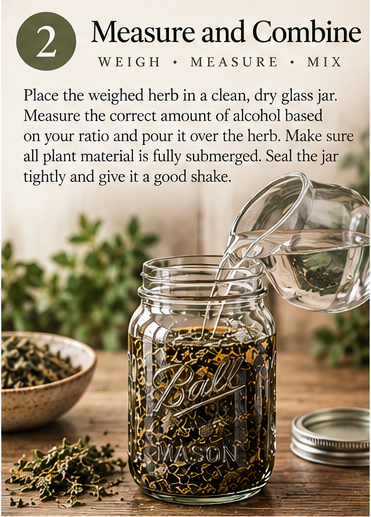
Pour the alcohol over your herbs.
The plant material should be thoroughly saturated. Close the jar tightly and shake it well. If the herb is really fluffy, you can chop it up of even powder it to make it fit better. It is really important that the alcohol fully covers the plant matter.
Step 3: Label It Immediately
Never rely on remembering what's in a jar several weeks later. BELIEVE ME!!! LEARN FROM MY MISTAKES…YOU WILL FORGET!
As soon as you prepare the tincture, label the jar.
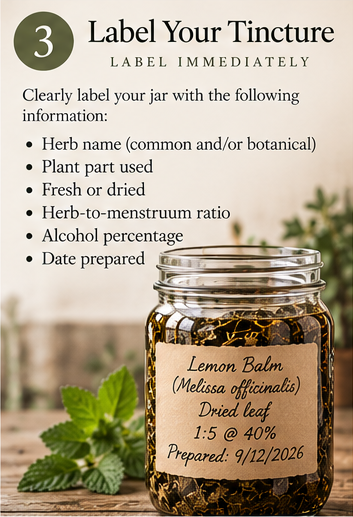
At minimum, record:
Herb name
Plant part used
Fresh or dried
Herb-to-menstruum ratio
Alcohol percentage
Date prepared
For example:
Chamomile — dried flower
1:5 @ 40%
Prepared: September 12, 2026
If you know the botanical name of your herb, including it is an excellent way to practice! .
Step 4: Let Your Tincture Macerate
The process of allowing plant material to soak in the menstruum is called maceration.
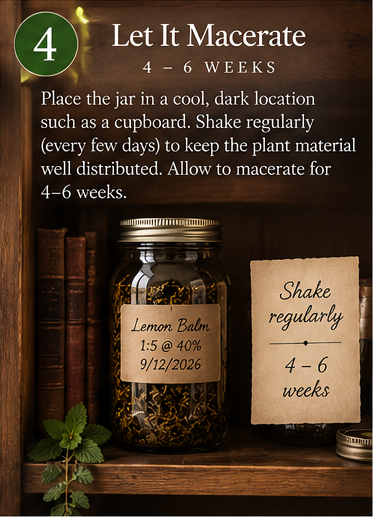
Place your tightly closed jar in a cool, dark location, such as a cupboard.
For this method, allow the tincture to macerate for approximately:
4–6 weeks
Shake the jar regularly during the maceration period. This redistributes the plant material and helps keep everything thoroughly exposed to the menstruum. Four to six weeks is a commonly used home maceration period, although extraction times can vary by preparation.
Check your jar periodically to make sure the plant material remains adequately saturated. It’s good practice to give it a quick shake regularly.
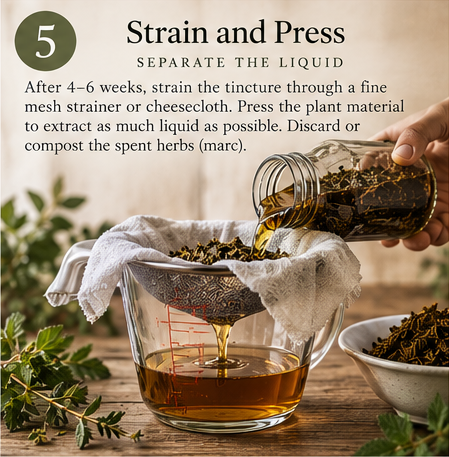
Step 5: Strain and Press
After 4–6 weeks, your tincture is ready to strain.
Place a fine-mesh strainer or cheesecloth over a clean bowl or measuring container and pour the tincture through it.
Press or squeeze the saturated herbs—the spent plant material is known as the marc—to recover as much of the liquid extract as reasonably possible.
Discard or compost the spent herbs when appropriate.
The liquid you've collected is your finished tincture!!! Congrats!
Step 6: Bottle and Label Your Finished Tincture
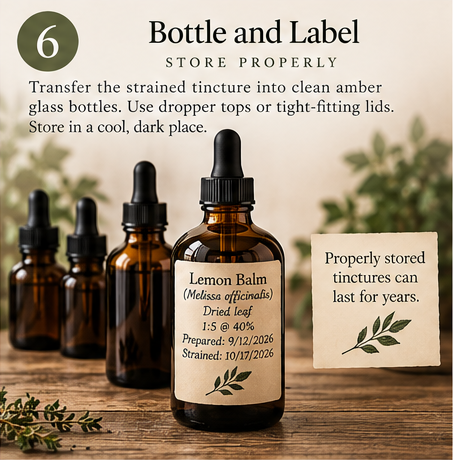
Transfer the strained tincture into clean amber glass bottles with tightly fitting caps or droppers.
Amber glass helps reduce the tincture's exposure to light, while storing the bottles in a cool, dark location provides additional protection.
Your final bottle should again be labeled. This time, include:
Herb name and botanical name, if known
Plant part
Fresh or dried
Extraction ratio
Alcohol percentage
Date originally prepared
Date strained/bottled
For example:
Herb Name (Botanical name)
Dried leaf
1:5 @ 40% alcohol
Prepared: 9/12/26
Strained/Bottled: 10/17/26
Properly prepared alcohol tinctures have a long shelf life. Keeping them tightly sealed and protected from excessive light and heat helps preserve their quality.
Choosing the Alcohol Percentage
This is where tincture making becomes more individualized.
The 1:5 @ 40% method above is a useful general example for many dried herbs, but it should not be applied automatically to every plant.
The appropriate alcohol concentration depends on what you're extracting.
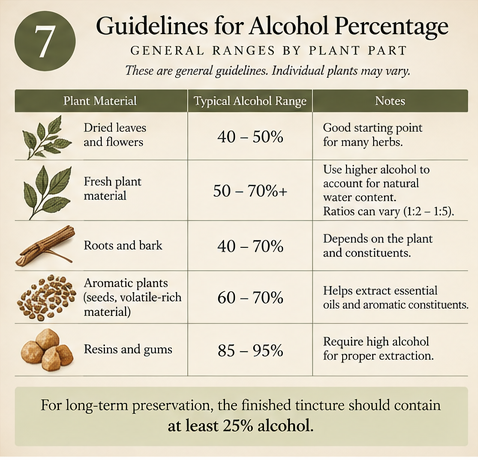
Many dried leaves and flowers
Approximately 40–50% alcohol is a useful general range for many dried herbs. The water portion helps rehydrate dried plant tissue and extracts water-soluble constituents, while the alcohol extracts constituents with greater alcohol solubility.
Fresh herbs
Fresh plants already contain a significant amount of water.
That water becomes part of the extraction and dilutes the alcohol you started with. For this reason, fresh-plant tinctures frequently use a higher starting alcohol percentage and a more concentrated plant-to-menstruum ratio.
Depending upon the particular plant, fresh tinctures may be prepared around 1:2 to 1:5, with alcohol concentrations commonly ranging from roughly 50–70% or higher. Some very juicy or otherwise specialized plants may require stronger alcohol like 95% grain alcohol.
This is one reason a fresh-herb tincture shouldn't simply be made by substituting fresh herb into a dried-herb recipe.
Roots and bark
Roots and bark do not automatically require 70% alcohol.
The appropriate percentage depends upon the chemistry of the particular plant. Some roots contain constituents that extract well in relatively water-rich menstruums, while aromatic or resinous roots may benefit from substantially more alcohol.
As a broad educational range, approximately 40–70% is encountered frequently for roots and bark, but the specific plant should determine the formula rather than the plant part alone.
Aromatic herbs and high-moisture plants
Higher concentrations around 60–70% can be useful for highly aromatic material and certain fresh, high-moisture plants. This range can help extract volatile aromatic constituents while compensating for water contributed by fresh plant tissue.
Resins and gums
Resinous material is very different.
Resins are poorly soluble in water and generally require a very high alcohol concentration—often approximately 85–95%—to extract effectively. This is one of the situations where high-proof alcohol genuinely has an important purpose.
Why the Final Alcohol Percentage Matters
Alcohol isn't only an extraction solvent. It is also the preservative.
As a general formulation guideline, the finished tincture should contain at least approximately 25% alcohol for reliable long-term preservation.
This distinction is especially important when working with fresh plants.
If you pour 40% alcohol over a very juicy fresh herb, the water contained within the plant will dilute that alcohol. The final tincture therefore won't necessarily remain at 40%.
That is why both the starting alcohol concentration and the plant's natural water content need to be considered when designing a fresh-plant tincture.
* The ratios and alcohol percentages in this article are general educational guidelines. If you have been provided with an individualized herbal formula or are preparing a specific tincture as part of your herbal plan, follow the preparation instructions provided with that formula or discuss the preparation with me directly.
